There is a question that comes before any discussion of chess: how did a single game — with its rigid rules and its small board — survive the collapse of empires, the turnover of languages, and the invention of every other amusement? Games usually die with the cultures that bore them. This one crossed from India to Persia, from Persia to Baghdad and Córdoba, from al-Andalus to Europe, then on to Moscow and Reykjavík and New York, and finally to a phone screen in the hands of a teenager who could not find Samarkand on a map. At every stop the game changed its skin a little, and stayed itself.
Before we begin, a small correction worth stating plainly: chess is not literally thousands of years old. It is about fifteen centuries old — which is enough, on its own, to make it one of the few things humans have practised almost without interruption. The legends tracing it to the pharaohs or to ancient sages in Babylon are lovely, but neither the archaeology nor the texts support them. The evidence we actually hold begins in northern India in the sixth century, and from there the thread can be followed with reasonable confidence.
The army of four divisions
The game's earliest ancestor was called chaturaṅga, a Sanskrit word meaning "having four limbs," used for the ancient Indian army and its divisions: infantry, cavalry, elephants, and chariots. The game was an abstraction of that army on a board of sixty-four squares — a board most likely borrowed, in the first place, from older Indian games played with dice.
The pieces of chaturaṅga map cleanly onto ours: the infantry became pawns, the cavalry knights, the chariots rooks, and the elephants what English calls the bishop. Above them stood the rajah — the king — and his counsellor.
The essential difference between that game and ours is not shape but tempo. It was very slow. The counsellor moved one square diagonally. The elephant made a short, limited jump. A game could run for hours of cautious manoeuvring before either side so much as touched the other. Play chess today under chaturaṅga's rules and you feel you are watching a film at quarter speed.
And yet it held enough genius to be worth carrying: no dice, no luck, no hidden information. Everything on the table, and the loser lost because he erred. That idea — that the game mirrors the mind rather than fortune — is what let it travel.
From the Indus to the court of Ctesiphon
The game passed into Sasanian Persia in the sixth century, where it became chatrang. A fine founding story travelled with it, told in a short Pahlavi text known as the Wizārishn ī Chatrang and retold by Ferdowsi in the Shahnameh: the king of India sent Khosrow Anushirvan a board, a set of pieces, and a challenge — that Persia's sages deduce the rules unaided, or else pay tribute. The vizier Bozorgmehr solved it, then returned the challenge by inventing the game of nard and sending it to India, where it defeated them.
The story is almost certainly literature rather than history, but it reveals something true: the game entered the courts as a test of political intelligence, not as an entertainment for the crowd. And from Persian we take the two words we still say: shah, the king, and shah mat — the king is helpless, stunned, without escape. You say it in English as checkmate and in French as échec et mat; in both cases it is the same Persian phrase after a long journey across tongues.
The Baghdad era: when the game became a science
With the Muslim conquest of Persia in the seventh century the game passed to the Arabs, and the word was arabised into shatranj. And here came the most important transformation in its entire history before the Renaissance: for the first time, it was written down.
In Baghdad, Samarra and Basra a class of professionals emerged, known as al-ʿāliyāt — the highest rank of player. Al-ʿAdlī al-Rūmī wrote the first chess book we know of in the ninth century, followed by Abū Bakr al-Ṣūlī (d. 946), companion of caliphs, transmitter and poet, whose fame ran so far that he became a proverb: "he plays chess like al-Ṣūlī." His student al-Lajlāj wrote on the theory of openings.
What these men did was not merely to play well. They invented the idea of studying the game:
- They graded players into five classes by strength — in essence the rating concept we will see return a thousand years later as Elo.
- They recorded openings and named them (taʿbiya, the initial arrangement of the pieces).
- They devised manṣūbāt: composed problems in which the player must find mate in a set number of moves. These are the direct ancestor of the puzzles published today in newspapers and phone apps.
- They developed a descriptive notation for recording moves, so that a game could pass from memory onto paper — and that is the moment chess acquired a written history.
This period also produced the famous story of the grain: the game's inventor asks the king for one grain of wheat on the first square, two on the second, four on the third, doubling to the sixty-fourth — and the king discovers that all the wheat in his kingdom will not cover it. Arabic sources attribute the request to a sage named Sissa ibn Dahir. It is humanity's first popular lesson in exponential growth, and mathematics textbooks still teach it that way.
The game also provoked a long jurisprudential debate: is it idle amusement of the blameworthy kind, or permitted exercise of the mind? The scholars divided, and the dispute usually turned on two conditions — that it must not distract from prayer, and that no wager may enter it. The argument is worth pausing over, because it is the first time the game was asked: what does it do to the person who plays it?
Crossing into Europe
Chess entered Europe through three doors at roughly the same time, around the tenth century: al-Andalus first and most consequentially, then Islamic Sicily, then Byzantium from the east. The earliest material and textual evidence carries that mark plainly: a Latin poem about chess preserved at the Swiss abbey of Einsiedeln, dating to the late tenth century, and the will of Count Ermengol I of Urgell in 1008, bequeathing his chess pieces to a monastery — a small detail that says a great deal. The pieces were treasure, made of rock crystal and ivory, and were inherited.
Among the most famous survivals of that age are the Lewis Chessmen, a set carved from walrus ivory, found on the Isle of Lewis in Scotland and dating to the twelfth century, probably of Norwegian make. Their scowling, grim faces have become the visual emblem of the whole game — kings seated with swords across their knees, and warders biting their shields in anxiety.
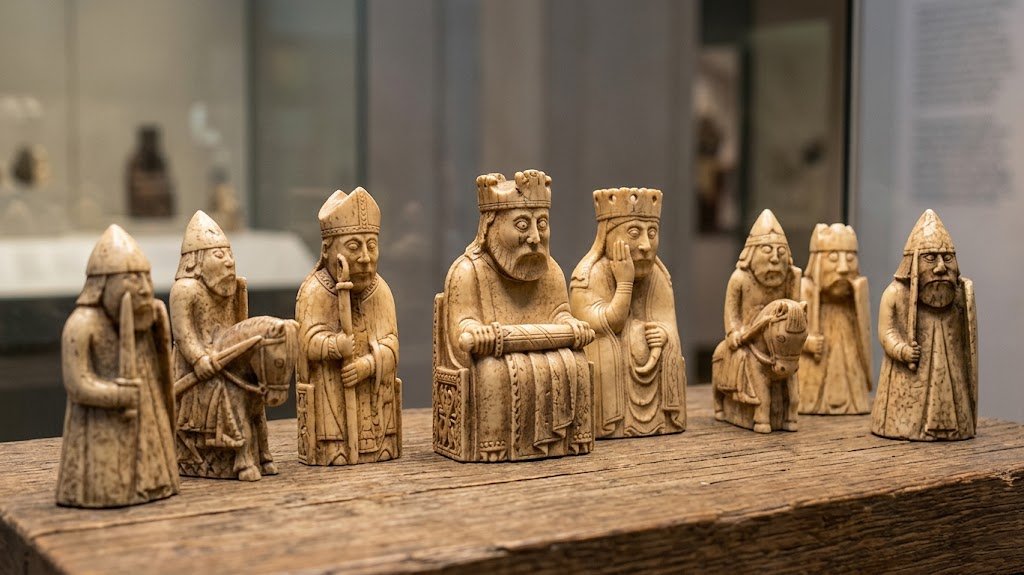
But Europe in those centuries was playing the slow game, inherited unchanged: the counsellor crawling one square, the elephant making its short hop. A game of nobles and monks, more present in literature and painting than in competition.
The mad queen: the revolution of the fifteenth century
Then, somewhere between Valencia and northern Italy in the closing decades of the fifteenth century, came the overturning.
The counsellor — that weak, crawling piece — became the queen, the strongest piece on the board, sweeping ranks, files and diagonals without limit. The elephant turned from a short jumper into a long-range slider. The pawn gained the right to advance two squares on its first move, and castling appeared.
The result was effectively a different game. In Spain and Italy it was called the mad queen's chess — scacchi alla rabiosa — because its speed looked like madness by the measure of the old game. A match that had taken a hundred moves of crawling could now be settled in twenty. Openings became dangerous, early attack became possible, and a single mistake became fatal.
Scholars note a striking coincidence — though any causal link remains conjecture — between the queen's rise on the board and the rise of actually reigning queens in Europe, Isabella of Castile foremost among them. Perhaps the game reflected its world; perhaps it was chance. What is notable is that the change happened in the same geography and in the same decades.
Documentation of the new game followed quickly: Lucena's book, printed in Salamanca in 1497, collecting openings and problems and containing endgame studies still taught under his name. Then the Spanish priest Ruy López, who published a systematic analysis in 1561 and whose name still sits on one of the most famous openings in the world.
The café, the pawns, and the soul
In the eighteenth century the game's centre moved to Paris, and specifically to the Café de la Régence, where players and philosophers met alike — Diderot, Rousseau and Voltaire passed through, and later Napoleon and Franklin.
Out of that café came François-André Philidor, a composer by trade with successful operas to his name, and without question the strongest player of his age. In his Analyse du jeu des Échecs (1749) he wrote the sentence that changed how the game was understood: the pawns are the soul of chess.
What he meant was that structure precedes tactics: the shape of the pawn chains decides in advance where the game will be played, which pieces will be effective and which imprisoned. Before him, chess was the art of direct attack and acrobatic sacrifice; after him it had a grammar. Philidor played three games at once blindfolded, which his contemporaries counted among the wonders of the age and wrote up in the newspapers.
Tournaments, and a first world champion
The nineteenth century gave the game its institutional shape. In 1851 London hosted the first international tournament, on the margins of the Great Exhibition, and it was won by the German Adolf Anderssen, known for games of such loud attacking beauty that one of them is simply called the Immortal. In the 1850s the American Paul Morphy appeared like a meteor: he swept the strongest players in Europe in a single tour, then retired from the game entirely at twenty-two and lived the rest of his life in seclusion in New Orleans.
In 1886 the first match formally described as a world championship was played, and Wilhelm Steinitz won it. Steinitz matters for more than his title: he is the man who turned chess from an art into a method. He argued that attack is not a right but an entitlement — that it may be launched only when small positional advantages have accumulated: control of the centre, a sound pawn structure, a weak square in the opponent's camp. The idea looks obvious today precisely because it won so completely.
After him came Emanuel Lasker, mathematician and philosopher, who held the title for twenty-seven years — a record never broken. Then the Cuban José Raúl Capablanca, with a mysterious simplicity that looked effortless, then Alexander Alekhine with his storming complexity. And in 1924 the International Chess Federation, FIDE, was founded in Paris under its motto: we are all one family.
A cold war on a board
After the Second World War, the Soviet Union adopted chess as a national project: schools, coaches, tournaments, and salaries for professionals. The result was near-total dominance for half a century, begun by Mikhail Botvinnik — an electrical engineer by profession — and continued by Smyslov, Tal, Petrosian and Spassky.
Then came 1972. In Reykjavík, the American Bobby Fischer sat down opposite the Soviet Boris Spassky in a match that became a global political event. One man, with no system behind him, against the apparatus of an entire state. The world followed it on television, live broadcasts of games that ran five hours each in silence. Fischer won, and for a moment chess was the most famous game on earth. Then Fischer vanished from the world, and left it behind.
In the 1980s and 1990s the torch passed to one of the greatest rivalries in the history of any sport: Karpov against Kasparov — five matches for the title, more than a hundred and seventy official games between them, and two opposed styles: the quiet strangle against dynamic violence.
The machine takes the opposite chair
From the beginning, the pioneers of computing saw chess as an ideal proving ground for machine intelligence: its rules are simple and closed, yet its space of possibilities is beyond counting.
In 1948 Alan Turing wrote a paper chess algorithm he called Turochamp and executed it by hand — calculating every move with a pencil — because no computer existed that could run it. In 1950 Claude Shannon published his founding paper, "Programming a Computer for Playing Chess," laying out the architecture that would govern chess programs for half a century: a search tree over possible moves, and an evaluation function assigning every position a number.
In 1997, in New York, IBM's Deep Blue defeated the world champion Garry Kasparov. It was a symbolic moment larger than its technical result, and many read it as a defeat of the human mind. The truth is quieter: Deep Blue was not thinking. It was calculating two hundred million positions per second according to rules written by people.
Then 2017 inverted the picture again. AlphaZero was taught no human chess knowledge beyond the rules; it played millions of games against itself within hours and discovered the openings and the principles on its own — some of them contradicting what humans had settled on over centuries, such as its willingness to give up material for long-term piece activity. What it offered was not merely superiority, but a different taste in play, which humanity then set about imitating.
The paradox is that none of this killed the game. Many expected chess to lose its meaning once the computer was permanently stronger than any human. The opposite happened: the engine became a coach in every player's pocket, the standard among the young rose sharply, and games came to be narrated to audiences move by move with an evaluation bar on screen, exactly as a football match is narrated through its statistics.
Why it did not die
In 2020 two things coincided: a world shut inside its homes, and a television series about a chess player. Registrations on the digital platforms multiplied, and streaming filled with players talking through their games aloud to audiences of hundreds of thousands. A fifteen-hundred-year-old game found itself at the centre of internet culture without needing a single rule changed.
And that, I think, is the answer to the question we began with. Chess survived because it offers a rare bargain: rules a child learns in an hour, and a depth no one exhausts in a lifetime. It hides nothing — every piece is visible to your opponent — and still nobody can see what is coming. There is no luck in it to console you when you lose; you lost because you erred, and you can go back through the game and find the exact move where you went wrong.
And in every age it has been a mirror of its owner: a military exercise in India, a test of wisdom at the Persian court, a written and classified science in Baghdad, a noble luxury in the palaces of Europe, then a stage for the Cold War, then a proving ground for artificial intelligence. The questions put to it changed. The board did not.
Sixty-four squares, thirty-two pieces, and a number of possible games that exceeds the count of atoms in the visible universe. That is enough to explain fifteen centuries of insomnia.